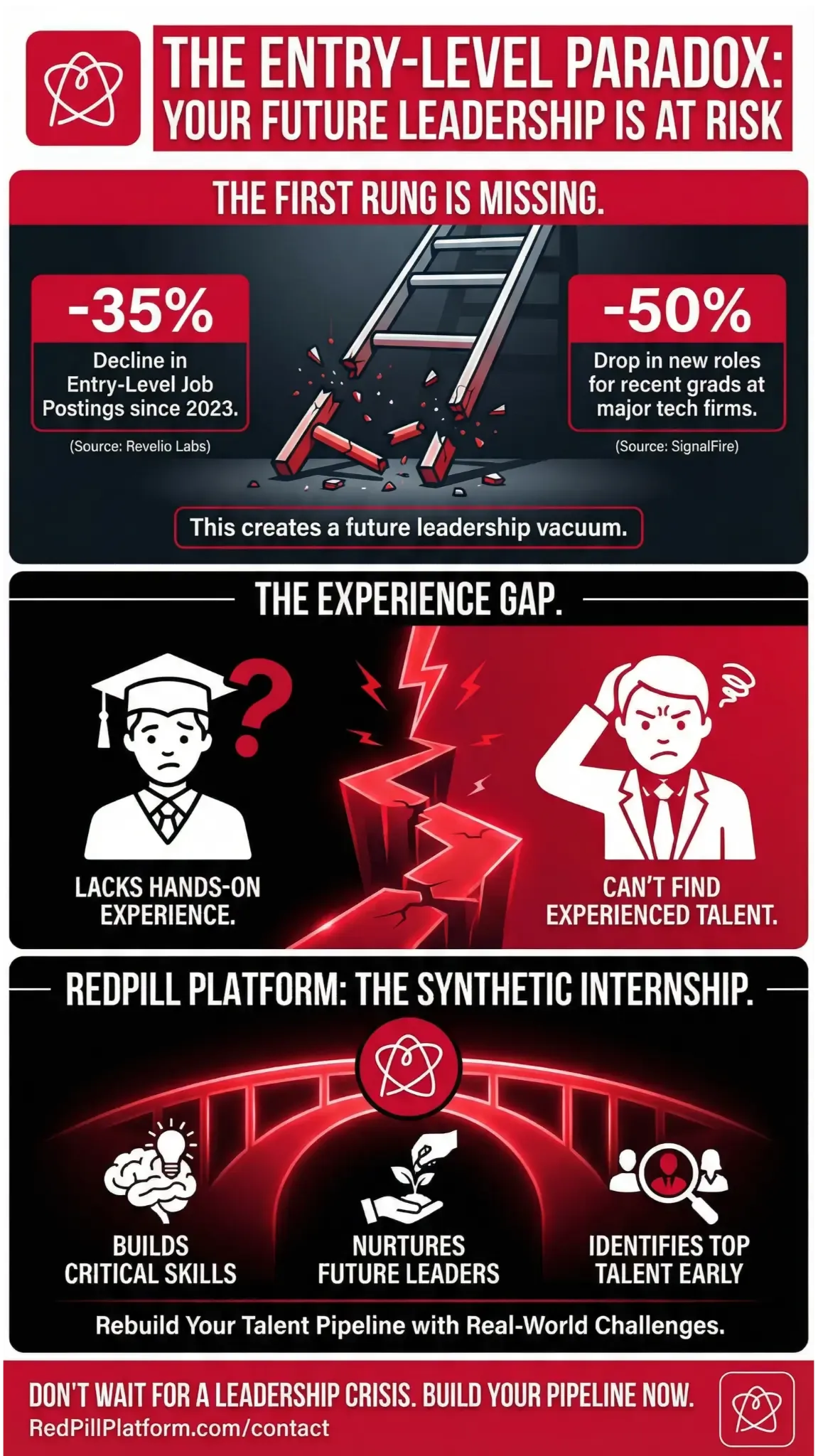
A fundamental pillar of corporate talent development is breaking. For generations, entry-level jobs served as the essential training ground where junior talent learned the ropes, honed foundational skills, and began their climb up the career ladder. Today, that first rung is rapidly disappearing.
The widespread automation of routine tasks by AI has led to a dramatic decline in the availability of these crucial roles, creating a dangerous paradox for companies: how do you cultivate the senior leaders of tomorrow when there are no junior roles for them to learn in today?
The Broken Rung on the Career Ladder
The data paints a stark picture of this "entry-level paradox." A landmark 2025 study from Stanford University found a 13% relative decline in employment for early-career workers (ages 22-25) in occupations most exposed to generative AI. This is not an isolated finding. According to labor research firm Revelio Labs, overall postings for entry-level jobs in the U.S. have plummeted by 35% since January 2023. The tech sector, a bellwether for AI adoption, has seen a staggering 50% decline in new roles for recent graduates at major firms between 2019 and 2024.
This isn't just a cyclical downturn; it's a structural shift. The World Economic Forum reports that 40% of employers expect to further reduce their workforce where AI can automate tasks. The consequence is a hollowing out of the junior talent pipeline, leaving a generation of bright, ambitious graduates with fewer opportunities to gain the very experience companies require.
The Rise of the "Synthetic Internship"
If companies are no longer providing the foundational training for their future leaders, where will that experience come from? The answer lies in a new model of talent development: the "synthetic internship." This approach uses real-world, project-based learning to provide the hands-on experience that is vanishing from the traditional workplace. It allows students to develop critical skills in a practical context, bridging the gap between academic knowledge and industry needs.
These experiential learning platforms are emerging as a critical solution to the entry-level crisis. They provide a structured environment for students to work on complex problems, collaborate with peers, and receive mentorship from industry experts. This model offers a powerful alternative to the traditional internship, which is often limited in scope and availability.
The RedPill Platform: Your Experiential Bridge to Future Talent
The RedPill Platform is at the forefront of this new talent development paradigm. We provide the "synthetic internship" experience that your company needs to build its future leadership pipeline. Our platform connects you with a global pool of ambitious students who are eager to prove their skills by solving your real-world business challenges.
By posting a challenge on the RedPill Platform, you are not just finding a solution to a problem; you are actively cultivating your next generation of talent. You provide the hands-on experience that is no longer available in traditional entry-level roles, allowing students to develop the critical thinking, problem-solving, and collaborative skills that are essential for success in the AI era.
References
- Erik Brynjolfsson, Bharat Chandar, and Ruyu Chen, "Canaries in the Coal Mine? Six Facts about the Recent Employment Effects of Artificial Intelligence," Stanford Digital Economy Lab, August 26, 2025.
- "AI isn't just ending entry-level jobs. It's ending the career ladder," CNBC, September 7, 2025.
- "If Entry-Level Jobs Are Vanishing, Where Will the Future Executives Come From?" IvyExec, August 12, 2025.