
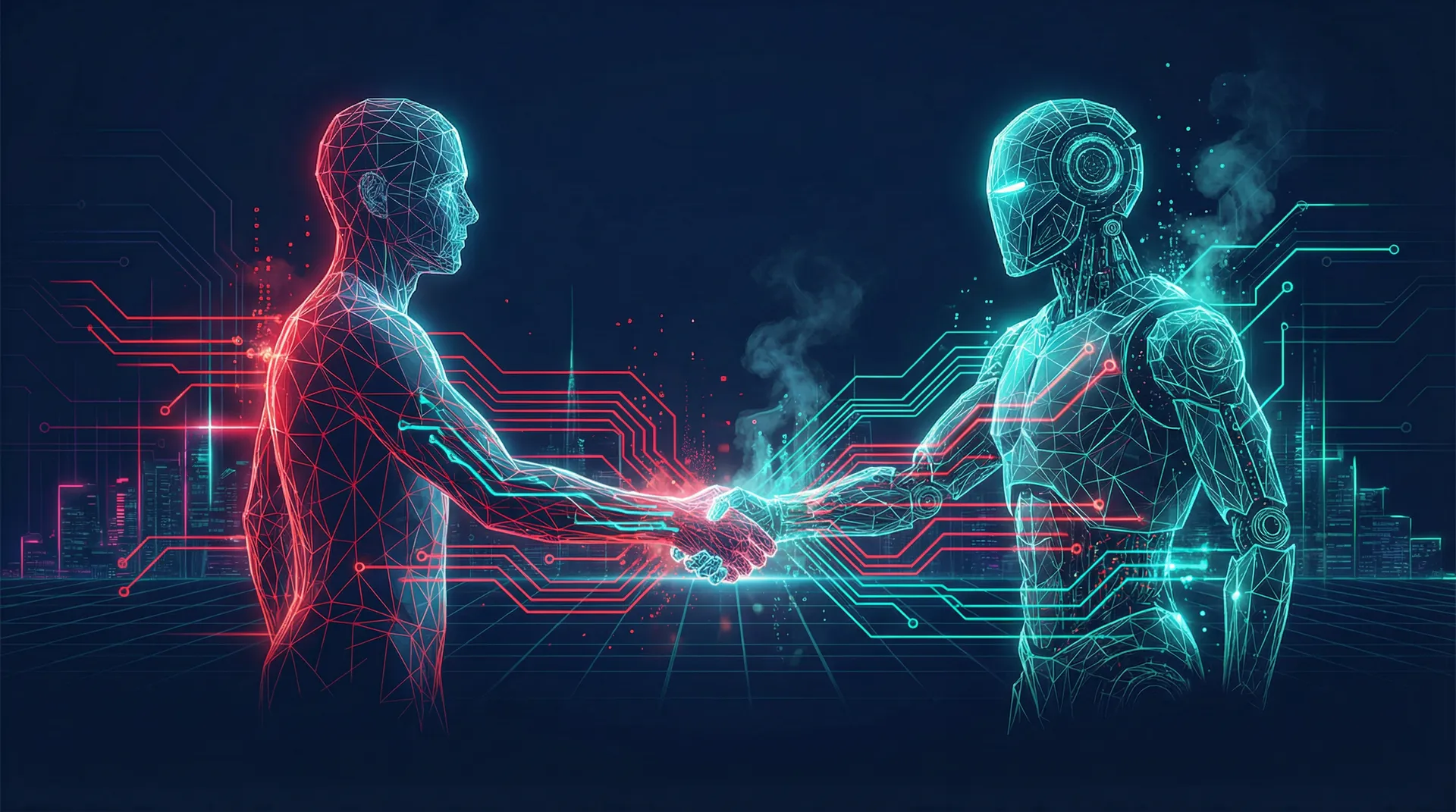
The initial wave of AI adoption was focused on prompt engineering—the skill of asking an AI the right question to get a desired output. In 2026, that is no longer enough. As AI becomes a ubiquitous commodity, the competitive advantage has shifted from simply using AI to supervising it.
The most valuable employees are no longer just those who can leverage AI, but those who can critically evaluate, guide, and augment its output. This is the era of the "Human-AI Power Couple," a symbiotic partnership where human judgment and machine efficiency combine to create unprecedented value.
Beyond Prompt Engineering
The narrative has decisively moved on from the simplistic "AI vs. Humans" debate. As a 2025 McKinsey report highlights, the future of work lies in "skill partnerships" between people, AI agents, and robots. This collaboration involves a sophisticated interplay where AI handles the data processing and routine tasks, while humans provide the strategic oversight, ethical judgment, and creative problem-solving that machines lack. The World Economic Forum reinforces this, stating that to enable effective human-AI collaboration, companies must be able to measure and validate a new set of human skills.
This new reality presents a significant challenge for talent acquisition. How do you identify candidates who possess the nuanced ability to supervise AI? A resume can't show this. A standard interview can't prove it. The only way to truly assess this critical skill is to see it in action.
The Irreplaceable Value of Human Judgment
Despite the rapid advancements in AI, the technology still has fundamental limitations. AI models are powerful pattern-matching engines, but they lack true understanding, common sense, and ethical grounding. They can generate fluent text, but they cannot grasp the subtle context of a business negotiation. They can analyze vast datasets, but they cannot make a final, high-stakes decision that requires emotional intelligence and cultural awareness. This is where the human partner becomes indispensable.
As Gloat's 2025 analysis on workforce collaboration puts it, the goal is to combine human expertise with AI tools to enhance productivity and decision-making. The most effective teams will be those that build a "human-in-the-loop" system, where human oversight is integrated at critical junctures to ensure the quality, accuracy, and ethical integrity of AI-driven work.
The RedPill Platform: Evaluating the AI-Augmented Human
The RedPill Platform is uniquely positioned to help you identify and cultivate the "AI supervisors" your company needs to thrive. Our real-world challenges provide the perfect environment to evaluate a candidate's ability to work effectively in a human-AI partnership. We can design challenges that require participants to not only produce a final output but also to document their process of using AI tools, justify their decisions, and critically evaluate the AI-generated content.
This allows you to assess a candidate's ability to critically evaluate AI output, apply ethical judgment, and integrate human creativity. By using the RedPill Platform, you can move beyond simply asking candidates if they have "AI skills" and start verifying their ability to be an effective AI supervisor. This is the key to building a future-proof workforce that can harness the full potential of the AI revolution.
References
- "AI: Work partnerships between people, agents, and robots," McKinsey Global Institute, November 25, 2025.
- "4 ways to enhance human-AI collaboration in the workplace," World Economic Forum, January 13, 2025.
- "AI and Human Collaboration in the Workforce," Gloat, June 5, 2025.
